

Insider Threat Risk
The insider threat remains one of the most serious concerns, with 70% of organizations in the Middle East identifying internal actors as their primary security risk.


The modern threat landscape is increasingly driven by risks originating from inside the organization. This creates several critical security challenges:
The insider threat remains one of the most serious concerns, with 70% of organizations in the Middle East identifying internal actors as their primary security risk.
Stolen credentials continue to be a leading cause of breaches, allowing attackers to impersonate legitimate users. In the first half of 2025, identity-based attacks increased by 32%, with most incidents involving password guessing or infostealer malware.
Legitimate users or automated agents are manipulated into performing unauthorized actions because their permissions are overly broad or static. Poorly scoped access rights enable unauthorized data extraction, even without traditional malware or exploits.
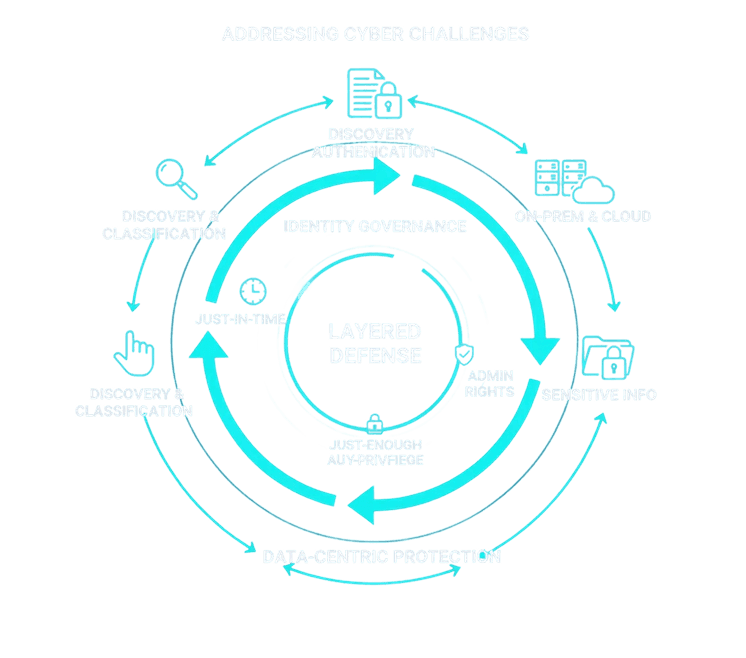
We address these challenges by implementing a layered defense that combines identity governance with data-centric protection. By discovering and classifying sensitive information across on-premises and cloud environments, our team ensures that data is protected based on its actual value and sensitivity. Our approach to identity involves "Just-In-Time" and "Just-Enough-Privilege" policies, ensuring that administrative rights are only granted when needed and for the minimal duration required.
We address these challenges by implementing a layered defense that combines identity governance with data-centric protection. By discovering and classifying sensitive information across on-premises and cloud environments, our team ensures that data is protected based on its actual value and sensitivity. Our approach to identity involves "Just-In-Time" and "Just-Enough-Privilege" policies, ensuring that administrative rights are only granted when needed and for the minimal duration required.
Solutions that use pattern matching, fingerprints, and machine learning to identify and stop unauthorized sharing of PII, financial records, or intellectual property.
Technology that embeds security policies directly into the file level. This ensures that even if data is moved or shared externally, it remains encrypted and only accessible to authorized users with specific permissions (e.g., view only, no print, no forward).
Credential vaulting and session recording for administrative accounts, preventing the misuse of high-level permissions.
A policy architecture that assigns permissions based on job roles, streamlining onboarding and reducing the risk of "permission creep".
Dynamic elevation of permissions that requires approval and provides full audit trails for sensitive actions.



Healthcare providers rely on DLP, DRM and IAM to ensure compliance with HIPAA and other data privacy regulations while enabling secure telemedicine.
The Finance sector uses identity governance to prevent fraud and ensure that only authorized personnel can access sensitive customer financial data.
In the Legal sector, RBAC and PAM are used to protect client confidentiality and ensure that sensitive case files are only accessible to the assigned legal team.
Choosing UpArrow Systems for data and identity governance ensures that Security is embedded into every infrastructure layer. UpArrow's solutions are "audit-ready," providing the documented controls and forensic evidence necessary to pass rigorous regulatory inspections (e.g., SOC 2, ISO 27001) with zero findings. By shifting the security burden from users to intelligent systems such as automated offboarding, DRM-persistent protection and JIT access, UpArrow reduces the risk of human error while improving operational efficiency.


