

Weaponized Agentic AI
Attackers now use autonomous AI agents to scan networks, launch adaptive phishing campaigns, and execute intrusions at scale with minimal human involvement.


The emergence of AI-driven attacks is fundamentally reshaping the cyber threat landscape. This creates several critical challenges:
Attackers now use autonomous AI agents to scan networks, launch adaptive phishing campaigns, and execute intrusions at scale with minimal human involvement.
Adversaries manipulate an organization’s AI agents by injecting false information, causing persistent misinterpretation of security policies and trust boundaries. Traditional, human-dependent Security Operations Centers can no longer keep pace with the speed, volume, and automation of AI-driven attacks.
AI enables a single operator to perform attacks that previously required an entire cybercrime team, dramatically increasing attack frequency and impact.
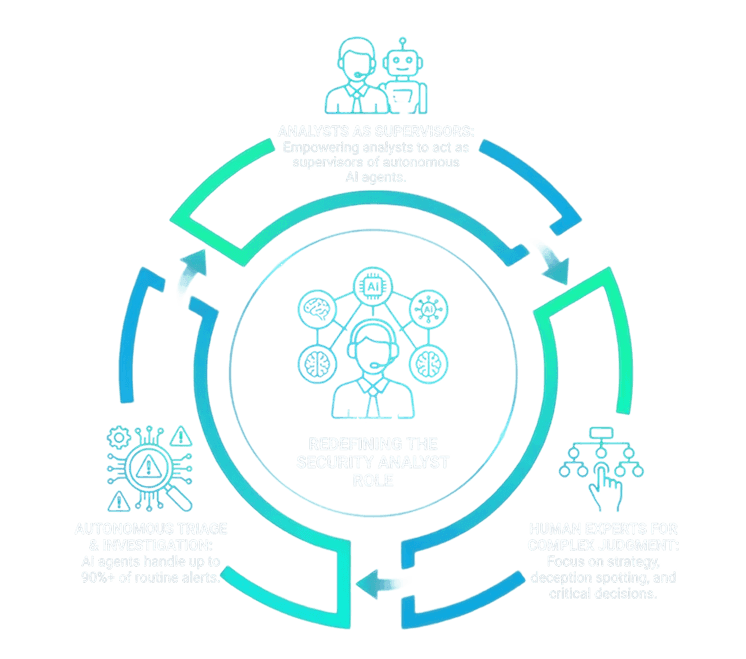
We addresses the AI challenge by redefining the role of the security analyst. Instead of manually executing every investigative step, our team empowers analysts to act as "Supervisors" of autonomous AI agents. By deploying Agentic SOC platforms that can autonomously triage and investigate up to 90%+ of routine alerts, we closes the time gap between intrusion and detection, allowing human experts to focus on complex judgment, strategy, and spotting deception.
We addresses the AI challenge by redefining the role of the security analyst. Instead of manually executing every investigative step, our team empowers analysts to act as "Supervisors" of autonomous AI agents. By deploying Agentic SOC platforms that can autonomously triage and investigate up to 90%+ of routine alerts, we closes the time gap between intrusion and detection, allowing human experts to focus on complex judgment, strategy, and spotting deception.
Fleets of specialized "Exabots" or agents that behave like Tier 1 to Tier 3 analysts, running across the full SOC lifecycle.
Engines that analyze millions of events per second to recognize hidden patterns and predict attacks before they materialize.
Conversational interfaces that enable natural language threat hunting without the need for complex SQL expertise.
Governance tools that ensure AI agents remain aligned with organizational policies and do not leak sensitive data.
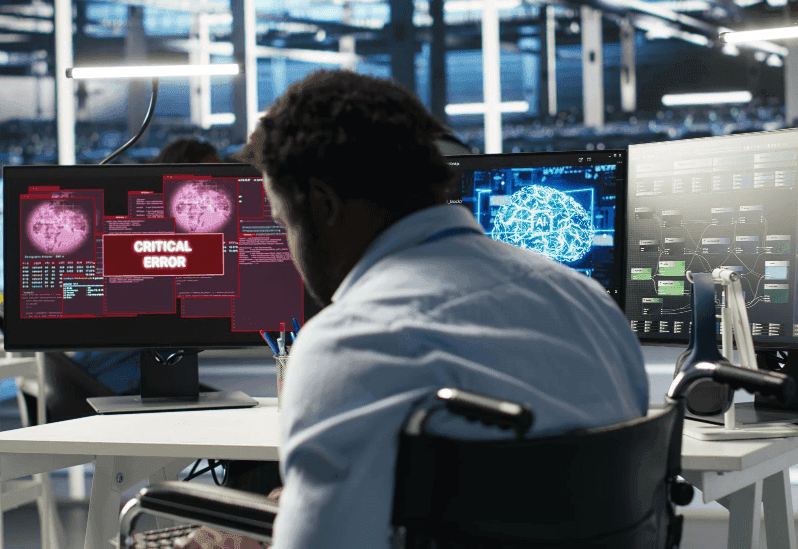
In High-Tech and Software Development, agentic platforms are used to automate everything from requirements analysis to operational monitoring, moving at the "speed of mission".
Large Smart City initiatives, such as NEOM in the GCC, use autonomous SOCs to manage thousands of IoT and OT devices that lack built-in security.
Manufacturing conglomerates use predictive AI to prevent cascading failures in complex energy and industrial systems.
UpArrow Systems cuts through the "AI vendor chaos" by delivering pragmatic, battle-tested solutions. By partnering with UpArrow, organizations gain a "unique advantage" in a landscape where adversaries are already automated. Our platforms not only reduce the risk of human error but also elevate the security team's capabilities, allowing them to handle enterprise-level threats with limited headcount. This approach turns cybersecurity from a defensive necessity into a driver of innovation and long-term business success.


